 (0 users)


Cover NOT yet available in

Join up for 4K upload/download access
Your Rating (Click a star below)

Track List
01) Long Journey
02) Golden Gate Fog
03) Fourteen Turtles
04) Swing Shift
05) Butternut
06) Mondello
07) Catskill Thunder
08) Safety In Numbers
09) Serpa
10) Mean Low Water
11) Yankee Swamp
12) Early Frost
01) Long Journey
02) Golden Gate Fog
03) Fourteen Turtles
04) Swing Shift
05) Butternut
06) Mondello
07) Catskill Thunder
08) Safety In Numbers
09) Serpa
10) Mean Low Water
11) Yankee Swamp
12) Early Frost

3:56
4:56
3:43
4:43
5:25
3:30
3:22
6:29
5:17
3:38
4:28
3:21
Data Complete 90%
Total Rating
Total Rating
 (1 users)
Back Cover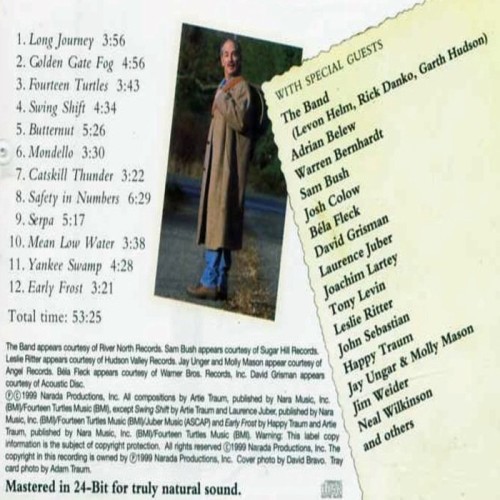
CD Art
3D Case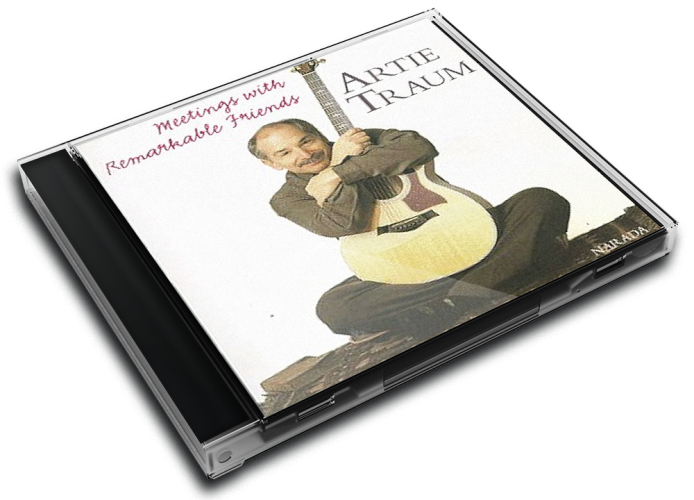
3D Thumb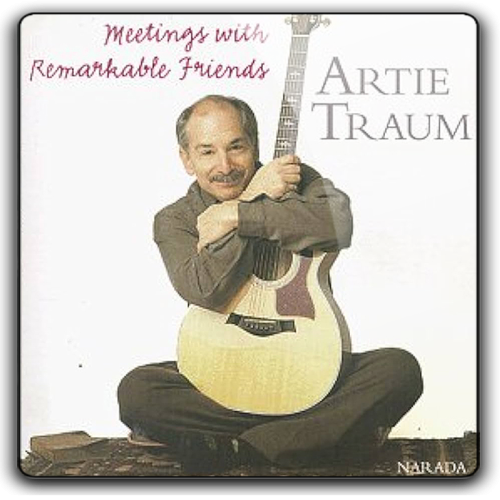
3D Flat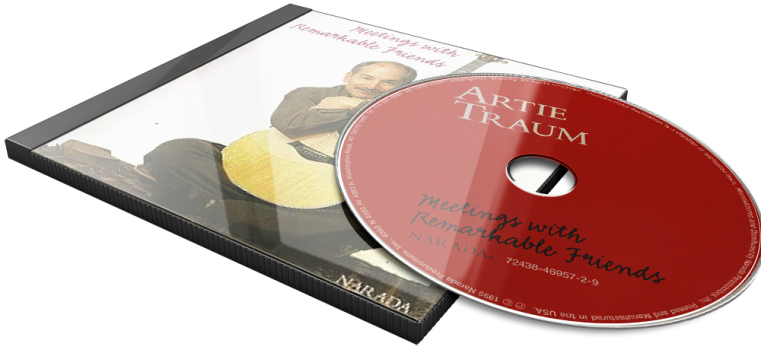
3D Face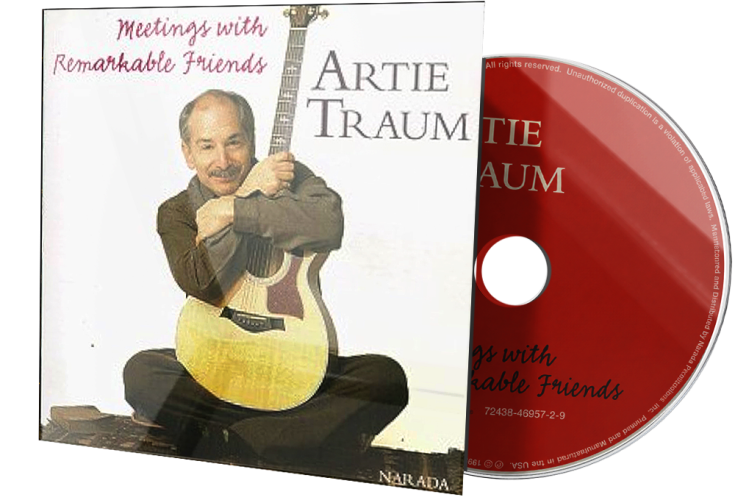
3D Spine
First Released
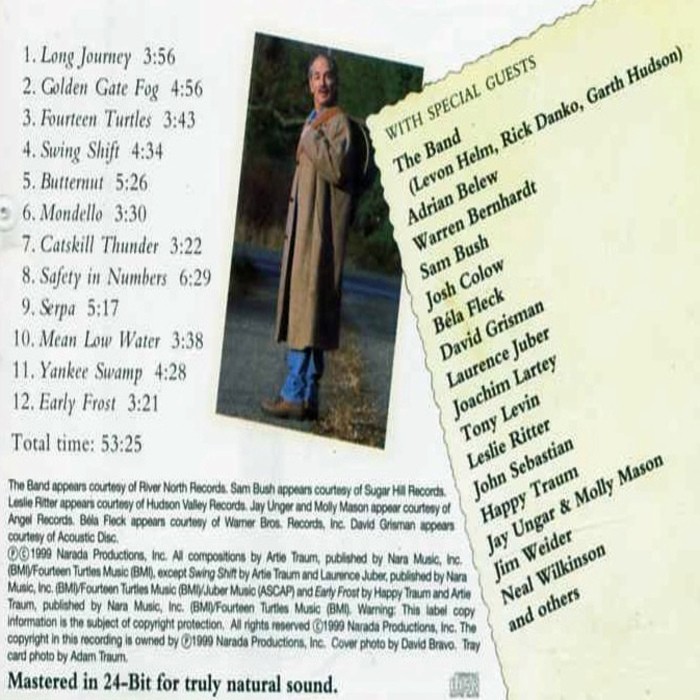
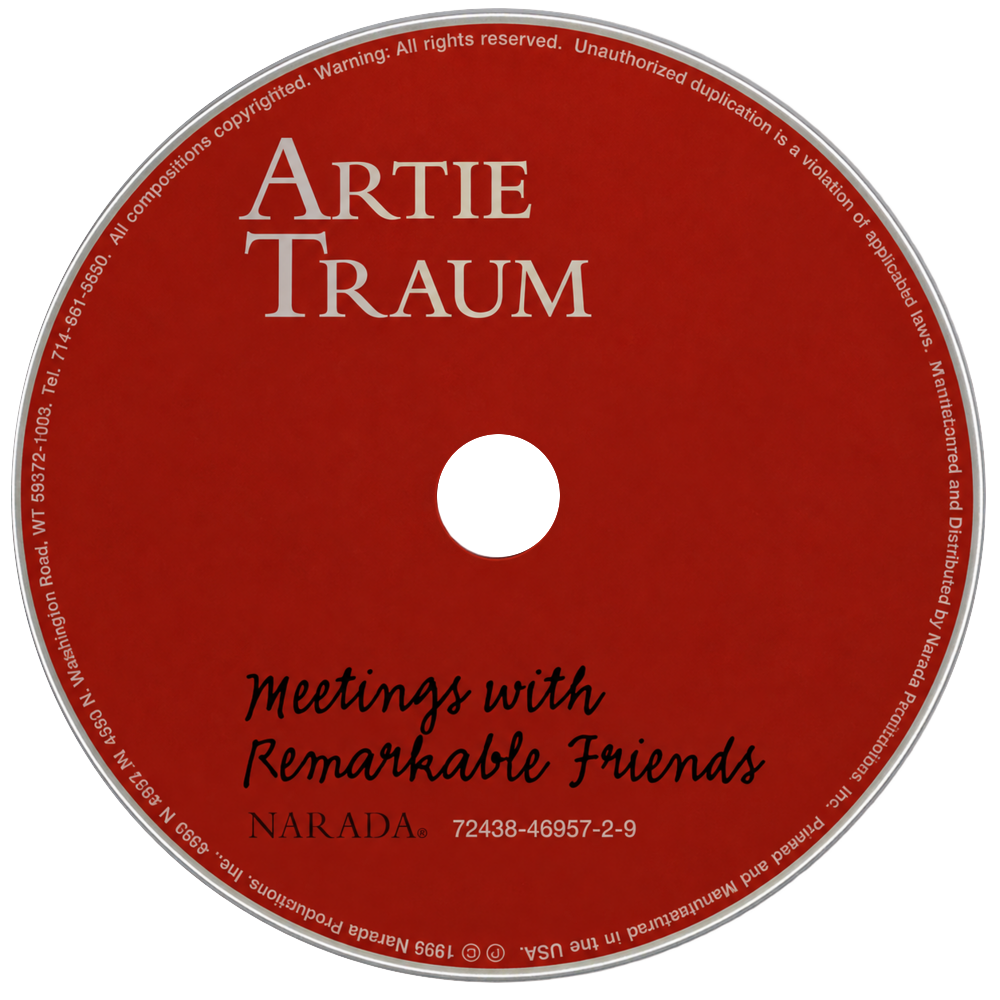
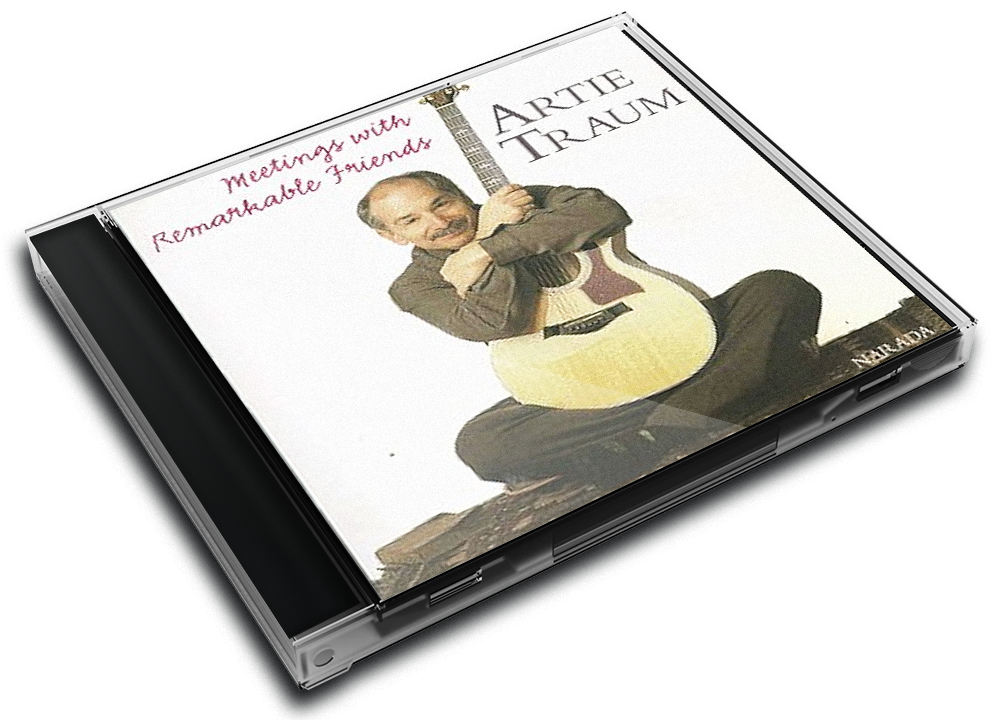
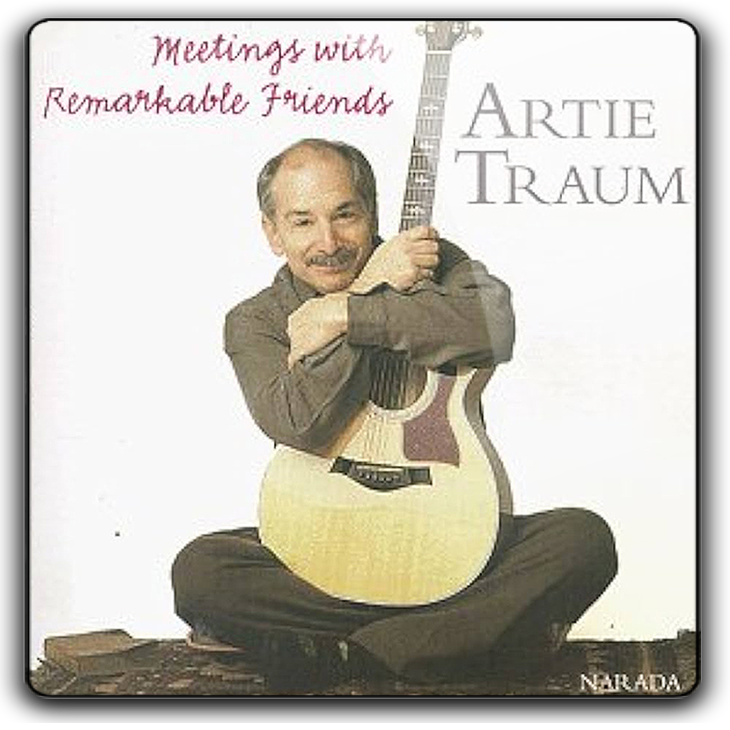

 1999
 Folk
 Reflective
 ---
---
 Medium
 Album
---
 ---
 0 copies
Album Description
Available in:

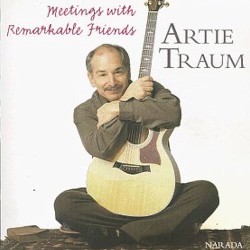
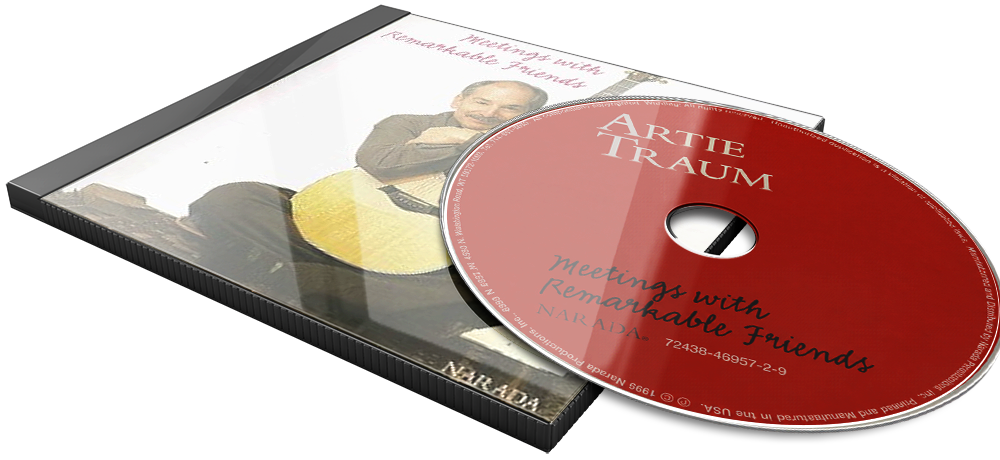
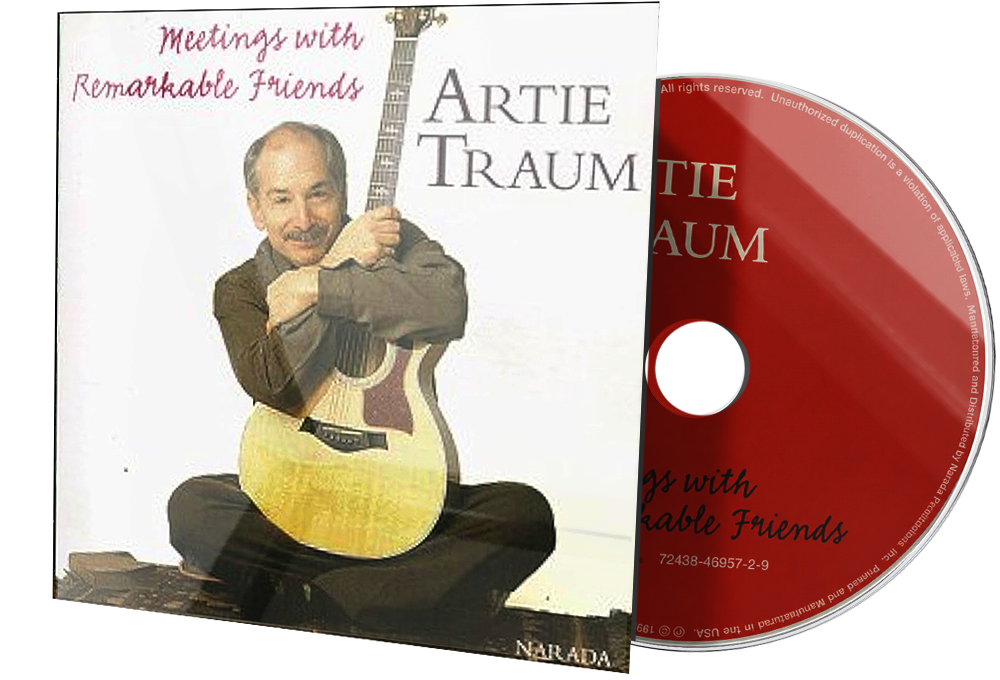
With Meetings with Remarkable Friends, American guitarist and composer Artie Traum released one of the most remarkable instrumental albums of his career in 1999. Released on Narada, the album features twelve compositions with a total playing time of approximately 53 minutes and combines acoustic folk, contemporary jazz, blues, bluegrass, and melodically oriented instrumental music. The focus is not solely on Traum's virtuoso guitar playing but, above all, on the musical encounters with an extraordinary group of fellow musicians and friends. The guest artists include Laurence Juber, David Grisman, Béla Fleck, Sam Bush, Tony Levin, John Sebastian, Adrian Belew, and several members of The Band. The album title therefore also describes its artistic concept: different musical personalities come together in compositions that allow room for individual expression and collaborative performance.
Since the 1960s, Artie Traum had been one of the influential figures in the American folk and acoustic guitar scene. Together with his brother Happy Traum, he was closely associated with the musical community of Woodstock, which produced numerous important folk and rock musicians. His early musical experiences were shaped by traditional folk, blues, and the American singer-songwriter movement. Over the course of his career, however, he developed an increasing interest in jazz harmony and contemporary instrumental music. Particularly from the 1990s onward, he combined his roots in acoustic guitar music with melodically sophisticated compositions and an open-minded, cross-genre musical approach.
Following releases such as Letters from Joubee and Cayenne, Traum had already developed a distinctive instrumental style. Meetings with Remarkable Friends continued this approach but placed an even greater emphasis on collaboration with other musicians. The guests do not merely provide accompaniment; they play a decisive role in shaping the character of the individual pieces. These changing lineups give the album its extraordinary stylistic diversity. Nevertheless, Traum's melodically oriented guitar playing remains the unifying element throughout the production.
One distinctive feature is the carefully selected group of participating musicians. David Grisman and Sam Bush represent different traditions of American mandolin music, while Béla Fleck became known far beyond the boundaries of bluegrass through his innovative banjo playing. Laurence Juber contributes his sophisticated fingerstyle technique, and Tony Levin brings his experience in jazz, rock, and progressive music. John Sebastian represents the American folk and blues tradition, Adrian Belew experimental rock music and unconventional guitar sounds. The members of The Band, meanwhile, embody the combination of folk, blues, country, and rock that is particularly characteristic of American roots music.
The album opens with Long Journey, a composition whose title evokes the image of an extended musical or personal journey. Alongside Artie Traum's acoustic and slide guitar, the recording features Robbie Dupree on bass, Warren Bernhardt on piano, Dean Sharp on percussion, and Leslie Ritter on vocals. This gives the piece a somewhat different instrumentation from the predominantly instrumental tracks on the album. The interaction between guitar, piano, and voice creates a warm, melodically accessible atmosphere. Long Journey conveys a sense of musical departure and immediately introduces the stylistic openness of the release.
Golden Gate Fog follows as one of the album's particularly atmospheric compositions. Guest musician David Grisman contributes mandolin, bringing a playing style that combines traditional bluegrass techniques with jazz and other forms of American music. The two musicians are supported by Jay Anderson on bass and Dean Sharp on drums. The mandolin complements Traum's acoustic guitar with its bright, distinctive tone, creating an appealing contrast to the softer guitar lines. The composition develops a calm, almost impressionistic atmosphere in which melodic motifs and harmonic changes are more important than ostentatious virtuosity. The subtle interaction between guitar and mandolin is one of the particular strengths of this recording.
Fourteen Turtles subsequently introduces a musical atmosphere more strongly influenced by folk and blues. Artie Traum is accompanied here by John Sebastian, who plays both acoustic guitar and harmonica. Sebastian became particularly well known as a member of the American band The Lovin' Spoonful and is among the musicians who combined traditional American musical forms with contemporary pop and rock. His harmonica gives the composition an unmistakable roots atmosphere. The combination of acoustic guitar, harmonica, and rhythmic accompaniment recalls the storytelling tradition of American folk blues. The unusual title further emphasizes the playful character of the musical arrangement.
Swing Shift provides one of the album's most interesting guitar collaborations. The composition was written together with Laurence Juber, who also performs as the second acoustic guitarist. Juber, a former member of Paul McCartney's Wings, is one of the outstanding representatives of modern fingerstyle playing. The piece concentrates on the direct dialogue between two technically accomplished guitarists. Different picking techniques, rhythmic accents, and melodic figures complement one another in a lively musical exchange. Particularly appealing is the combination of Traum's melodically oriented playing and Juber's rhythmic precision. Swing Shift demonstrates how two independent guitar voices can create a cohesive yet varied composition.
Butternut expands the sound with clear influences from bluegrass and American string-band music. With Béla Fleck on banjo and Sam Bush on mandolin, the recording brings together two musicians who have made decisive contributions to the development of traditional bluegrass instruments. They are supported by Alison Prestwood on bass and Dean Sharp on drums and percussion. The interaction of guitar, banjo, and mandolin creates a lively, rhythmically flexible sound. The composition combines traditional acoustic instrumentation with a contemporary harmonic approach. Particularly remarkable is how naturally the different musical personalities blend into the shared arrangement.
With Mondello, the musical atmosphere changes once again. The title refers, among other things, to a coastal town in Sicily, suggesting a Mediterranean setting. Musically, Artie Traum is accompanied by Tony Levin on bass, Robbie Dupree on harmonica, and Joachim Lartey on percussion. Levin's bass playing, in particular, expands the harmonic foundation of the composition and adds depth to the arrangement. The percussion provides rhythmic flexibility, while the harmonica contributes a warm, melodic tone. Mondello is among the pieces that most clearly demonstrate Traum's interest in different musical cultures and rhythmic forms of expression.
Catskill Thunder subsequently moves into the musical landscape of the American Northeast. The Catskill Mountains were closely associated with the folk movement and the Woodstock music scene. Guest musicians include Jay Ungar on violin, Molly Mason on bass, Debbie Lan on keyboards, and Josh Colow on electric guitar. Ungar's expressive violin playing, in particular, gives the composition a melancholic, almost narrative atmosphere. The combination of acoustic guitar and violin recalls traditional American folk and country music, while the additional instrumentation expands the sound. Catskill Thunder is one of the album's most emotionally compelling pieces and demonstrates Traum's ability to transform landscapes and personal memories into musical images.
Safety in Numbers is the longest composition on the album. Tony Levin plays bass, Neal Wilkinson drums, and Josh Colow electric guitar. This lineup gives the piece a considerably stronger jazz- and rock-oriented character. Its extended playing time allows for a more elaborate development of musical motifs and rhythmic structures. Particularly interesting is the interaction between Traum's acoustic guitar and the electric instrumentation. The composition moves within the stylistic territory where contemporary jazz, melodic rock, and acoustic instrumental music intersect. Safety in Numbers demonstrates the album's openness to modern forms of musical expression.
Serpa continues the collaboration with Tony Levin and Neal Wilkinson but expands the lineup to include pianist Warren Bernhardt. The combination of acoustic guitar, piano, bass, and drums recalls the classic structure of a small jazz ensemble. The harmonic possibilities of the piano, in particular, complement Traum's melodic guitar playing and create room for sophisticated musical development. Within the album, Serpa is one of the pieces in which the influence of contemporary jazz is most clearly recognizable. The combination of rhythmic precision, harmonic diversity, and melodic accessibility forms an essential foundation of the composition.
Mean Low Water introduces a distinctly more rock-oriented musical encounter. Alongside Tony Levin on bass and Neal Wilkinson on drums, Adrian Belew contributes electric guitar. Belew became known through his work with King Crimson, David Bowie, and Talking Heads, developing an unmistakable playing style that combines experimental sound design with rhythmic complexity. His participation expands the album's sonic range with a more unconventional electric component. In combination with Traum's acoustic guitar, this creates an interesting contrast between traditional guitar techniques and modern rock aesthetics. Mean Low Water demonstrates how naturally Traum can bring different musical worlds together.
Yankee Swamp occupies a special place on the album, featuring Artie Traum performing alongside members of The Band. Rick Danko plays bass, Levon Helm drums and harmonica, Garth Hudson keyboards, and Jim Weider resonator guitar. This lineup brings together several of the most important representatives of the American roots-rock tradition. The composition has a pronounced blues and Americana character, further emphasized by Traum's electric guitar playing. The interaction between Garth Hudson's organ sounds, Levon Helm's rhythmic accompaniment, and the guitars gives the recording a powerful, earthy atmosphere. Yankee Swamp is one of the album's highlights because different musical experiences come together in an immediately engaging ensemble performance.
The album concludes with Early Frost, a composition written jointly by Artie Traum and his brother Happy Traum. Both musicians can be heard playing acoustic guitars. After the sometimes extensively instrumented pieces that precede it, the album returns to a particularly personal and restrained form of musical expression. The interaction between the two guitars creates a calm, reflective atmosphere that recalls their shared musical roots in the American folk movement. Early Frost therefore has not only musical but also biographical significance. As the closing piece, it emphasizes the importance of personal relationships and long-standing musical friendships that characterize the entire album.
One of the essential strengths of Meetings with Remarkable Friends lies in the extraordinary quality of its musical collaborations. The participating musicians come from different traditions and each contributes a distinctive instrumental language. Nevertheless, the result is not an arbitrary collection of unrelated guest appearances. Artie Traum's guitar playing and melodically oriented compositions provide a unifying framework within which the different influences can develop. This balance between individual freedom and musical cohesion is precisely what makes the release so appealing.
The stylistic diversity is equally remarkable. Elements of acoustic folk, contemporary jazz, blues, bluegrass, Americana, and melodic rock coexist on equal terms. The transitions between styles feel largely natural because they emerge from the musical personalities of the participating performers. Acoustic instruments, in particular, provide a shared sonic foundation, while electric guitars, keyboards, and drums introduce additional expressive possibilities. The album thus avoids a narrow stylistic identity and presents the acoustic guitar as a versatile instrument within different musical contexts.
The compositions themselves also deserve particular attention. With the exception of Swing Shift, written jointly with Laurence Juber, and Early Frost, composed by Artie and Happy Traum together, the pieces were written by Artie Traum. Their titles frequently evoke images of landscapes, places, encounters, and personal experiences. These associations beyond the music itself support the narrative character of the instrumental compositions. This is particularly evident in Golden Gate Fog, Catskill Thunder, and Yankee Swamp, whose musical arrangements create different atmospheric images.
The production places great emphasis on the detailed presentation of the participating instruments. Acoustic guitars, mandolins, banjo, violin, and harmonica retain their characteristic tonal qualities, while bass, drums, and electric instruments expand the musical foundation. The arrangements are designed to keep the individual contributions of the guest musicians recognizable. With a production featuring numerous different lineups, this transparency is particularly important. It allows listeners to follow the musical dialogues and appreciate the distinctive qualities of the various instrumentalists.
Meetings with Remarkable Friends occupies an outstanding position in Artie Traum's discography. The album combines his experiences from several decades of American folk and guitar music with his later exploration of jazz and contemporary instrumental music. At the same time, it documents his close personal and musical relationships with numerous important artists. The release received the award for Best Acoustic Instrumental Album of 1999 at the NAV Awards and attracted positive attention in the music press. Particular praise was directed toward the combination of compositional quality, instrumental diversity, and musical collaboration.
Meetings with Remarkable Friends is an exceptionally versatile and musically sophisticated album that presents Artie Traum as a sensitive guitarist, composer, and musical collaborator. The twelve compositions combine acoustic folk, contemporary jazz, blues, bluegrass, and Americana into a varied instrumental soundscape. Particularly impressive are the finely balanced musical dialogues, the outstanding contributions of the guest musicians, and the balance between melodic restraint and rhythmic energy. Highlights such as Golden Gate Fog, Swing Shift, Catskill Thunder, and Yankee Swamp demonstrate the extraordinary breadth of the release. A stylistically distinctive and atmospherically rich album that not only documents Artie Traum's musical abilities but, above all, brings the creative power of long-standing friendships and shared musical experiences vividly to life.

User Album Review
None...
External Album Reviews
None...
User Comments

Available in:
With Meetings with Remarkable Friends, American guitarist and composer Artie Traum released one of the most remarkable instrumental albums of his career in 1999. Released on Narada, the album features twelve compositions with a total playing time of approximately 53 minutes and combines acoustic folk, contemporary jazz, blues, bluegrass, and melodically oriented instrumental music. The focus is not solely on Traum's virtuoso guitar playing but, above all, on the musical encounters with an extraordinary group of fellow musicians and friends. The guest artists include Laurence Juber, David Grisman, Béla Fleck, Sam Bush, Tony Levin, John Sebastian, Adrian Belew, and several members of The Band. The album title therefore also describes its artistic concept: different musical personalities come together in compositions that allow room for individual expression and collaborative performance.
Since the 1960s, Artie Traum had been one of the influential figures in the American folk and acoustic guitar scene. Together with his brother Happy Traum, he was closely associated with the musical community of Woodstock, which produced numerous important folk and rock musicians. His early musical experiences were shaped by traditional folk, blues, and the American singer-songwriter movement. Over the course of his career, however, he developed an increasing interest in jazz harmony and contemporary instrumental music. Particularly from the 1990s onward, he combined his roots in acoustic guitar music with melodically sophisticated compositions and an open-minded, cross-genre musical approach.
Following releases such as Letters from Joubee and Cayenne, Traum had already developed a distinctive instrumental style. Meetings with Remarkable Friends continued this approach but placed an even greater emphasis on collaboration with other musicians. The guests do not merely provide accompaniment; they play a decisive role in shaping the character of the individual pieces. These changing lineups give the album its extraordinary stylistic diversity. Nevertheless, Traum's melodically oriented guitar playing remains the unifying element throughout the production.
One distinctive feature is the carefully selected group of participating musicians. David Grisman and Sam Bush represent different traditions of American mandolin music, while Béla Fleck became known far beyond the boundaries of bluegrass through his innovative banjo playing. Laurence Juber contributes his sophisticated fingerstyle technique, and Tony Levin brings his experience in jazz, rock, and progressive music. John Sebastian represents the American folk and blues tradition, Adrian Belew experimental rock music and unconventional guitar sounds. The members of The Band, meanwhile, embody the combination of folk, blues, country, and rock that is particularly characteristic of American roots music.
The album opens with Long Journey, a composition whose title evokes the image of an extended musical or personal journey. Alongside Artie Traum's acoustic and slide guitar, the recording features Robbie Dupree on bass, Warren Bernhardt on piano, Dean Sharp on percussion, and Leslie Ritter on vocals. This gives the piece a somewhat different instrumentation from the predominantly instrumental tracks on the album. The interaction between guitar, piano, and voice creates a warm, melodically accessible atmosphere. Long Journey conveys a sense of musical departure and immediately introduces the stylistic openness of the release.
Golden Gate Fog follows as one of the album's particularly atmospheric compositions. Guest musician David Grisman contributes mandolin, bringing a playing style that combines traditional bluegrass techniques with jazz and other forms of American music. The two musicians are supported by Jay Anderson on bass and Dean Sharp on drums. The mandolin complements Traum's acoustic guitar with its bright, distinctive tone, creating an appealing contrast to the softer guitar lines. The composition develops a calm, almost impressionistic atmosphere in which melodic motifs and harmonic changes are more important than ostentatious virtuosity. The subtle interaction between guitar and mandolin is one of the particular strengths of this recording.
Fourteen Turtles subsequently introduces a musical atmosphere more strongly influenced by folk and blues. Artie Traum is accompanied here by John Sebastian, who plays both acoustic guitar and harmonica. Sebastian became particularly well known as a member of the American band The Lovin' Spoonful and is among the musicians who combined traditional American musical forms with contemporary pop and rock. His harmonica gives the composition an unmistakable roots atmosphere. The combination of acoustic guitar, harmonica, and rhythmic accompaniment recalls the storytelling tradition of American folk blues. The unusual title further emphasizes the playful character of the musical arrangement.
Swing Shift provides one of the album's most interesting guitar collaborations. The composition was written together with Laurence Juber, who also performs as the second acoustic guitarist. Juber, a former member of Paul McCartney's Wings, is one of the outstanding representatives of modern fingerstyle playing. The piece concentrates on the direct dialogue between two technically accomplished guitarists. Different picking techniques, rhythmic accents, and melodic figures complement one another in a lively musical exchange. Particularly appealing is the combination of Traum's melodically oriented playing and Juber's rhythmic precision. Swing Shift demonstrates how two independent guitar voices can create a cohesive yet varied composition.
Butternut expands the sound with clear influences from bluegrass and American string-band music. With Béla Fleck on banjo and Sam Bush on mandolin, the recording brings together two musicians who have made decisive contributions to the development of traditional bluegrass instruments. They are supported by Alison Prestwood on bass and Dean Sharp on drums and percussion. The interaction of guitar, banjo, and mandolin creates a lively, rhythmically flexible sound. The composition combines traditional acoustic instrumentation with a contemporary harmonic approach. Particularly remarkable is how naturally the different musical personalities blend into the shared arrangement.
With Mondello, the musical atmosphere changes once again. The title refers, among other things, to a coastal town in Sicily, suggesting a Mediterranean setting. Musically, Artie Traum is accompanied by Tony Levin on bass, Robbie Dupree on harmonica, and Joachim Lartey on percussion. Levin's bass playing, in particular, expands the harmonic foundation of the composition and adds depth to the arrangement. The percussion provides rhythmic flexibility, while the harmonica contributes a warm, melodic tone. Mondello is among the pieces that most clearly demonstrate Traum's interest in different musical cultures and rhythmic forms of expression.
Catskill Thunder subsequently moves into the musical landscape of the American Northeast. The Catskill Mountains were closely associated with the folk movement and the Woodstock music scene. Guest musicians include Jay Ungar on violin, Molly Mason on bass, Debbie Lan on keyboards, and Josh Colow on electric guitar. Ungar's expressive violin playing, in particular, gives the composition a melancholic, almost narrative atmosphere. The combination of acoustic guitar and violin recalls traditional American folk and country music, while the additional instrumentation expands the sound. Catskill Thunder is one of the album's most emotionally compelling pieces and demonstrates Traum's ability to transform landscapes and personal memories into musical images.
Safety in Numbers is the longest composition on the album. Tony Levin plays bass, Neal Wilkinson drums, and Josh Colow electric guitar. This lineup gives the piece a considerably stronger jazz- and rock-oriented character. Its extended playing time allows for a more elaborate development of musical motifs and rhythmic structures. Particularly interesting is the interaction between Traum's acoustic guitar and the electric instrumentation. The composition moves within the stylistic territory where contemporary jazz, melodic rock, and acoustic instrumental music intersect. Safety in Numbers demonstrates the album's openness to modern forms of musical expression.
Serpa continues the collaboration with Tony Levin and Neal Wilkinson but expands the lineup to include pianist Warren Bernhardt. The combination of acoustic guitar, piano, bass, and drums recalls the classic structure of a small jazz ensemble. The harmonic possibilities of the piano, in particular, complement Traum's melodic guitar playing and create room for sophisticated musical development. Within the album, Serpa is one of the pieces in which the influence of contemporary jazz is most clearly recognizable. The combination of rhythmic precision, harmonic diversity, and melodic accessibility forms an essential foundation of the composition.
Mean Low Water introduces a distinctly more rock-oriented musical encounter. Alongside Tony Levin on bass and Neal Wilkinson on drums, Adrian Belew contributes electric guitar. Belew became known through his work with King Crimson, David Bowie, and Talking Heads, developing an unmistakable playing style that combines experimental sound design with rhythmic complexity. His participation expands the album's sonic range with a more unconventional electric component. In combination with Traum's acoustic guitar, this creates an interesting contrast between traditional guitar techniques and modern rock aesthetics. Mean Low Water demonstrates how naturally Traum can bring different musical worlds together.
Yankee Swamp occupies a special place on the album, featuring Artie Traum performing alongside members of The Band. Rick Danko plays bass, Levon Helm drums and harmonica, Garth Hudson keyboards, and Jim Weider resonator guitar. This lineup brings together several of the most important representatives of the American roots-rock tradition. The composition has a pronounced blues and Americana character, further emphasized by Traum's electric guitar playing. The interaction between Garth Hudson's organ sounds, Levon Helm's rhythmic accompaniment, and the guitars gives the recording a powerful, earthy atmosphere. Yankee Swamp is one of the album's highlights because different musical experiences come together in an immediately engaging ensemble performance.
The album concludes with Early Frost, a composition written jointly by Artie Traum and his brother Happy Traum. Both musicians can be heard playing acoustic guitars. After the sometimes extensively instrumented pieces that precede it, the album returns to a particularly personal and restrained form of musical expression. The interaction between the two guitars creates a calm, reflective atmosphere that recalls their shared musical roots in the American folk movement. Early Frost therefore has not only musical but also biographical significance. As the closing piece, it emphasizes the importance of personal relationships and long-standing musical friendships that characterize the entire album.
One of the essential strengths of Meetings with Remarkable Friends lies in the extraordinary quality of its musical collaborations. The participating musicians come from different traditions and each contributes a distinctive instrumental language. Nevertheless, the result is not an arbitrary collection of unrelated guest appearances. Artie Traum's guitar playing and melodically oriented compositions provide a unifying framework within which the different influences can develop. This balance between individual freedom and musical cohesion is precisely what makes the release so appealing.
The stylistic diversity is equally remarkable. Elements of acoustic folk, contemporary jazz, blues, bluegrass, Americana, and melodic rock coexist on equal terms. The transitions between styles feel largely natural because they emerge from the musical personalities of the participating performers. Acoustic instruments, in particular, provide a shared sonic foundation, while electric guitars, keyboards, and drums introduce additional expressive possibilities. The album thus avoids a narrow stylistic identity and presents the acoustic guitar as a versatile instrument within different musical contexts.
The compositions themselves also deserve particular attention. With the exception of Swing Shift, written jointly with Laurence Juber, and Early Frost, composed by Artie and Happy Traum together, the pieces were written by Artie Traum. Their titles frequently evoke images of landscapes, places, encounters, and personal experiences. These associations beyond the music itself support the narrative character of the instrumental compositions. This is particularly evident in Golden Gate Fog, Catskill Thunder, and Yankee Swamp, whose musical arrangements create different atmospheric images.
The production places great emphasis on the detailed presentation of the participating instruments. Acoustic guitars, mandolins, banjo, violin, and harmonica retain their characteristic tonal qualities, while bass, drums, and electric instruments expand the musical foundation. The arrangements are designed to keep the individual contributions of the guest musicians recognizable. With a production featuring numerous different lineups, this transparency is particularly important. It allows listeners to follow the musical dialogues and appreciate the distinctive qualities of the various instrumentalists.
Meetings with Remarkable Friends occupies an outstanding position in Artie Traum's discography. The album combines his experiences from several decades of American folk and guitar music with his later exploration of jazz and contemporary instrumental music. At the same time, it documents his close personal and musical relationships with numerous important artists. The release received the award for Best Acoustic Instrumental Album of 1999 at the NAV Awards and attracted positive attention in the music press. Particular praise was directed toward the combination of compositional quality, instrumental diversity, and musical collaboration.
Meetings with Remarkable Friends is an exceptionally versatile and musically sophisticated album that presents Artie Traum as a sensitive guitarist, composer, and musical collaborator. The twelve compositions combine acoustic folk, contemporary jazz, blues, bluegrass, and Americana into a varied instrumental soundscape. Particularly impressive are the finely balanced musical dialogues, the outstanding contributions of the guest musicians, and the balance between melodic restraint and rhythmic energy. Highlights such as Golden Gate Fog, Swing Shift, Catskill Thunder, and Yankee Swamp demonstrate the extraordinary breadth of the release. A stylistically distinctive and atmospherically rich album that not only documents Artie Traum's musical abilities but, above all, brings the creative power of long-standing friendships and shared musical experiences vividly to life.
User Album Review
None...
External Album Reviews
None...
User Comments
No comments yet...
Status
 unlocked
External Links


