 (1 users)


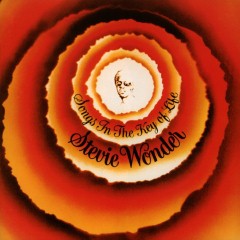
Cover NOT yet available in

Join up for 4K upload/download access
Your Rating (Click a star below)

Track List
01) Love's in Need of Love Today
02) Have a Talk With God
03) Village Ghetto Land
04) Contusion
05) Sir Duke
06) I Wish
07) Knocks Me Off My Feet
08) Pastime Paradise
09) Summer Soft
10) Ordinary Pain
Cd 2
01) Isn't She Lovely
02) Joy Inside My Tears
03) Black Man
04) Ngiculela - Es Una Historia - I Am Singing
05) If It's Magic
06) As
07) Another Star
Cd 3
01) Saturn
02) Ebony Eyes
03) All Day Sucker
04) Easy Goin' Evening (My Mama's Call)
01) Love's in Need of Love Today
02) Have a Talk With God
03) Village Ghetto Land
04) Contusion
05) Sir Duke
06) I Wish
07) Knocks Me Off My Feet
08) Pastime Paradise
09) Summer Soft
10) Ordinary Pain
Cd 2
01) Isn't She Lovely
02) Joy Inside My Tears
03) Black Man
04) Ngiculela - Es Una Historia - I Am Singing
05) If It's Magic
06) As
07) Another Star
Cd 3
01) Saturn
02) Ebony Eyes
03) All Day Sucker
04) Easy Goin' Evening (My Mama's Call)

7:05
2:42
3:25
3:45
3:54
4:12
3:36
3:27
4:14
6:23
6:33
6:27
5:56
3:48
3:11
7:09
8:01
4:53
4:08
5:05
3:56
Data Complete 80%
Total Rating
Total Rating
 (3 users)
Back Cover
CD Art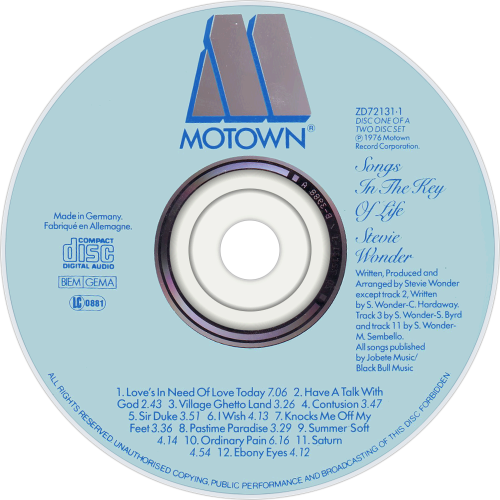
3D Case
3D Thumb
3D Flat
3D Face
3D Spine
First Released
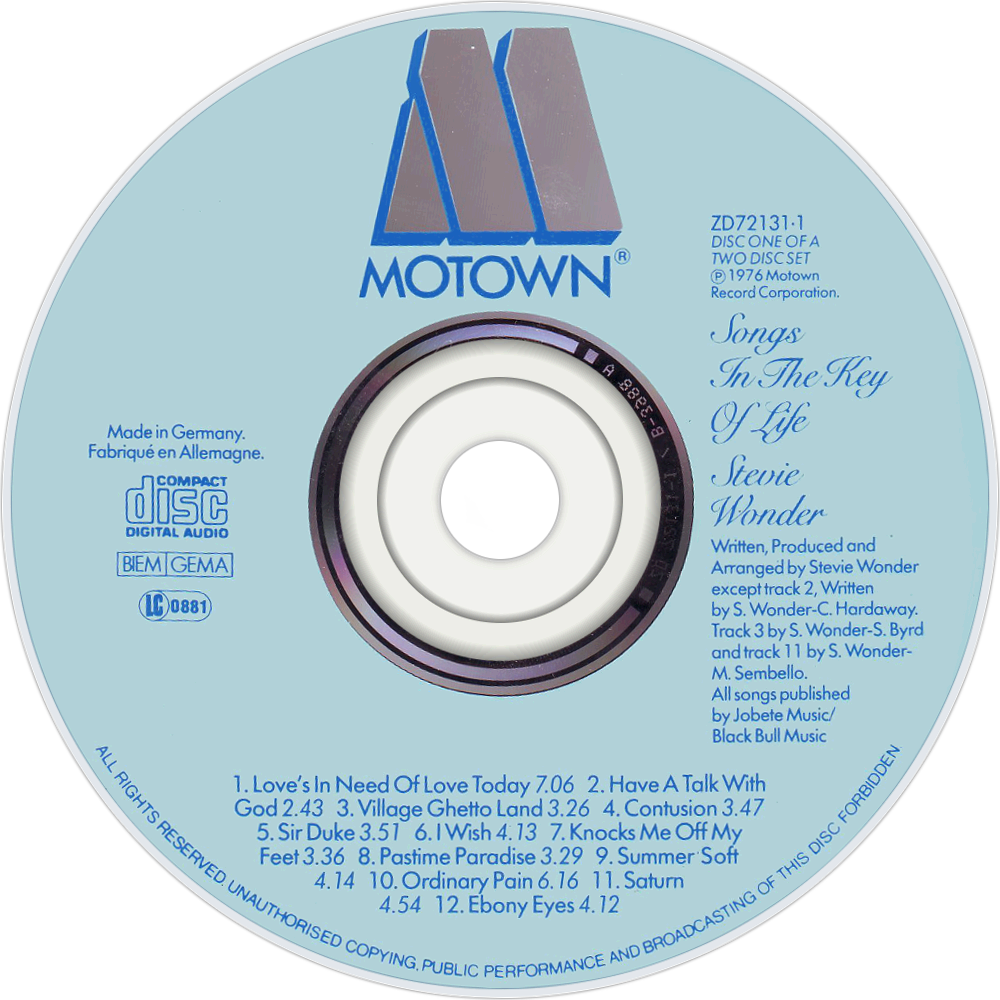
 1976
1976
 R&B
R&B
 In Love
 Urban/R&B
---
 Medium
 Album
Album
---
 ---
---
 0 copies
Album Description
Available in:


Songs in the Key of Life (1976) marque l’apogée de la « période classique » de Stevie Wonder chez Motown.
Cet ambitieux double LP, complété par un EP bonus, représente le sommet technique et créatif de l'artiste, fusionnant soul, jazz et funk avec une orchestration d'une densité rare.
Enregistré dans des studios de référence (Record Plant, Hit Factory), l'album se distingue par une production visionnaire et une complexité harmonique qui lui ont valu une reconnaissance critique universelle.
Classé parmi les plus grands albums de l'histoire, il est aujourd'hui préservé au National Recording Registry pour sa portée culturelle et esthétique majeure.

User Album Review
Months before the recording sessions for Songs in the Key of Life ended, the musicians in Stevie Wonder’s band had T-shirts made up that proclaimed, “We’re almost finished.” It was the stock answer to casual fans and Motown executives and everybody who’d fallen in love with Wonder’s early-Seventies gems – 1972’s Talking Book, 1973’s Innervisions, and 1974’s Fulfillingness’ First Finale – and who had been waiting two years for the next chapter. “I believed there was a lot that needed to be said,” Wonder said. More, in fact, than he could fit onto a double album – also included was a bonus EP, a seven-inch single with four more songs from the sessions.
Songs, released in 1976, encompasses an incredible range of life experiences – from the giddy joy of a baby in the bathtub (“Isn’t She Lovely,” featuring the cries and giggles of Wonder’s infant daughter Aisha Morris) through tributes to his musical heroes (“Sir Duke”) to dismay about the indifference of the wealthy (“Village Ghetto Land”). Wonder pulled from every imaginable musical source — the ecstatic “Sir Duke” references Duke Elington and Ella Fitzgerald, while “As” featured Herbie Hancock on Fender Rhodes.
Though Wonder’s blindness meant he could record faster by memorizing lyrics, some songs had four or five intricate verses, so somebody had to prompt him. Often it was engineer John Fischbach, reading lines into the headphone mix just seconds before Wonder sang them. “He never got thrown off,” engineer John Fischbach told Rolling Stone years later. “His vocals had so much power.”
The album’s mastery of many styles remains astonishing, but the feat might not have meant so much had Wonder not delivered some of his most impassioned political art as well, like the autobiographical “I Wish,” the takedown of wealthy complacency “Village Ghetto Land,” and, perhaps most movingly, “Black Man,” in which he runs down a funky list of global Afro-diasporic aspirations and heroes. Songs in the Key of Life linked all this together, in Wonder’s all-encompassing innervision.
External Album Reviews


 pitchfork.com/reviews/albums/22174-songs-in-the-key-of-life/
User Comments

Available in:
Songs in the Key of Life (1976) marque l’apogée de la « période classique » de Stevie Wonder chez Motown.
Cet ambitieux double LP, complété par un EP bonus, représente le sommet technique et créatif de l'artiste, fusionnant soul, jazz et funk avec une orchestration d'une densité rare.
Enregistré dans des studios de référence (Record Plant, Hit Factory), l'album se distingue par une production visionnaire et une complexité harmonique qui lui ont valu une reconnaissance critique universelle.
Classé parmi les plus grands albums de l'histoire, il est aujourd'hui préservé au National Recording Registry pour sa portée culturelle et esthétique majeure.
User Album Review
Months before the recording sessions for Songs in the Key of Life ended, the musicians in Stevie Wonder’s band had T-shirts made up that proclaimed, “We’re almost finished.” It was the stock answer to casual fans and Motown executives and everybody who’d fallen in love with Wonder’s early-Seventies gems – 1972’s Talking Book, 1973’s Innervisions, and 1974’s Fulfillingness’ First Finale – and who had been waiting two years for the next chapter. “I believed there was a lot that needed to be said,” Wonder said. More, in fact, than he could fit onto a double album – also included was a bonus EP, a seven-inch single with four more songs from the sessions.
Songs, released in 1976, encompasses an incredible range of life experiences – from the giddy joy of a baby in the bathtub (“Isn’t She Lovely,” featuring the cries and giggles of Wonder’s infant daughter Aisha Morris) through tributes to his musical heroes (“Sir Duke”) to dismay about the indifference of the wealthy (“Village Ghetto Land”). Wonder pulled from every imaginable musical source — the ecstatic “Sir Duke” references Duke Elington and Ella Fitzgerald, while “As” featured Herbie Hancock on Fender Rhodes.
Though Wonder’s blindness meant he could record faster by memorizing lyrics, some songs had four or five intricate verses, so somebody had to prompt him. Often it was engineer John Fischbach, reading lines into the headphone mix just seconds before Wonder sang them. “He never got thrown off,” engineer John Fischbach told Rolling Stone years later. “His vocals had so much power.”
The album’s mastery of many styles remains astonishing, but the feat might not have meant so much had Wonder not delivered some of his most impassioned political art as well, like the autobiographical “I Wish,” the takedown of wealthy complacency “Village Ghetto Land,” and, perhaps most movingly, “Black Man,” in which he runs down a funky list of global Afro-diasporic aspirations and heroes. Songs in the Key of Life linked all this together, in Wonder’s all-encompassing innervision.
External Album Reviews
pitchfork.com/reviews/albums/22174-songs-in-the-key-of-life/
User Comments
No comments yet...
Status
 unlocked
External Links


