 (4 users)


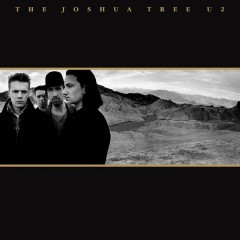
Cover NOT yet available in

Join up for 4K upload/download access
Your Rating (Click a star below)

Track List
01) Where the Streets Have No Name
03) With or Without You 
04) Bullet the Blue Sky
05) Running to Stand Still
11) Mothers of the Disappeared
02) I Still Haven't Found What I'm Looking For
06) Red Hill Mining Town
07) In God's Country
08) Trip Through Your Wires
09) One Tree Hill
10) Exit
01) Where the Streets Have No Name
03) With or Without You
04) Bullet the Blue Sky
05) Running to Stand Still
11) Mothers of the Disappeared
02) I Still Haven't Found What I'm Looking For
06) Red Hill Mining Town
07) In God's Country
08) Trip Through Your Wires
09) One Tree Hill
10) Exit

5:37
4:56
4:32
4:19
5:11
4:39
4:54
2:57
3:32
4:43
4:53
Data Complete 90%
Total Rating
Total Rating
 (9 users)
Back Cover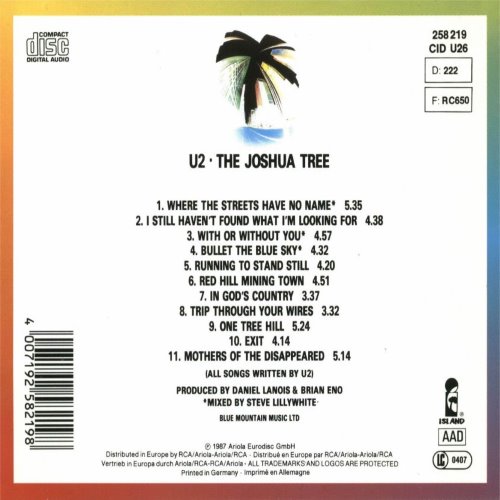
CD Art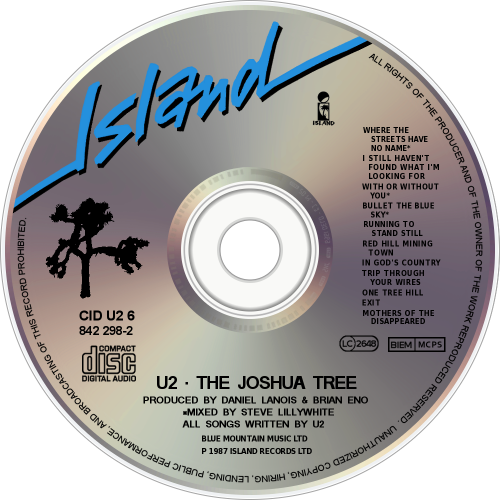
3D Case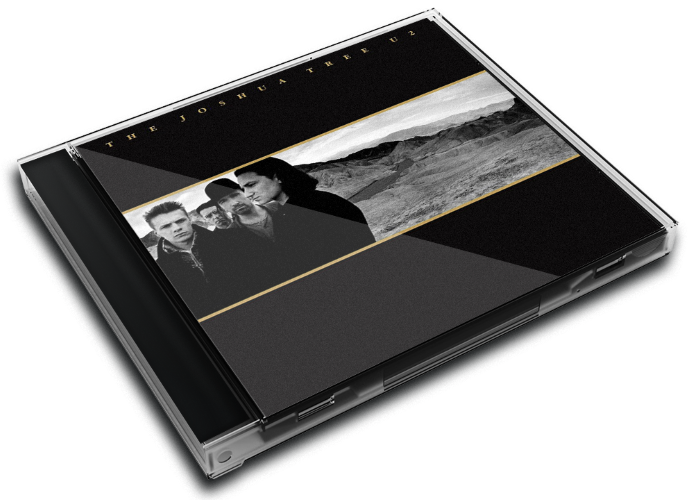
3D Thumb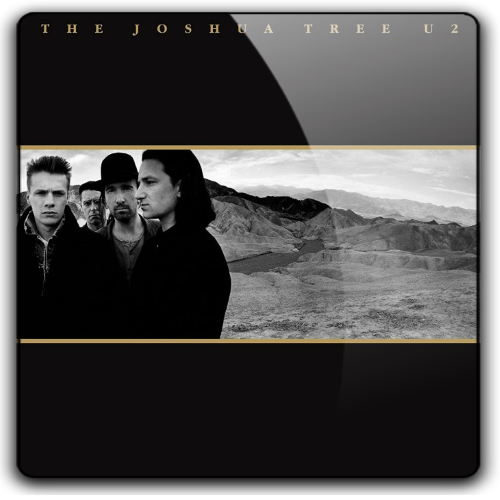
3D Flat
3D Face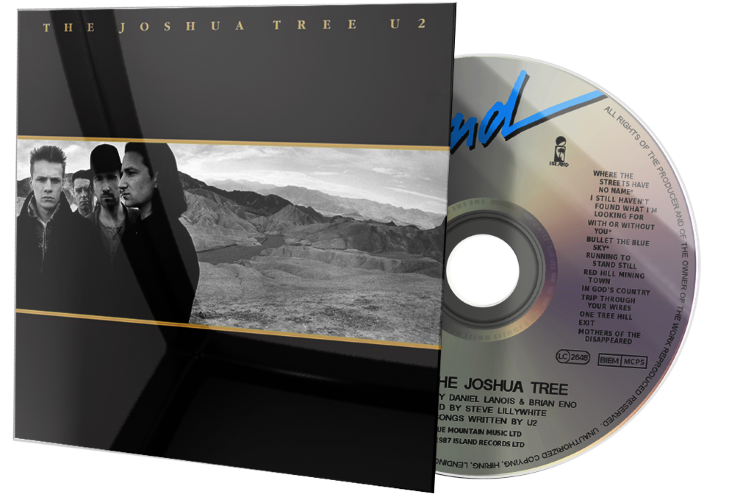
3D Spine
First Released



 1987
1987
 Pop-Rock
 Political
 Rock/Pop
---
 Medium
 Album
Album
54/100
 00602517449398
 25,000,000 copies
Album Description
Available in:


Sorti le 9 mars 1987 sur Island Records, The Joshua Tree marque le passage de U2 du statut de groupe à succès à celui de superstars mondiales.
Produit par Daniel Lanois et Brian Eno, cet album rompt avec les expérimentations ambiantes de The Unforgettable Fire pour privilégier une approche plus directe et structurée, ancrée dans les racines du rock, du blues et du folk américain.
Porté par une fascination profonde — mêlée de critique sociale — pour les grands espaces et le rêve américain, le disque capture une atmosphère « cinématographique » unique. Les singles iconiques « With or Without You », « I Still Haven't Found What I'm Looking For » et « Where the Streets Have No Name » illustrent parfaitement cette maturité artistique.
Récompensé par deux Grammy Awards en 1988, dont celui de l'album de l'année, l'ouvrage s'est vendu à plus de 25 millions d'exemplaires. En explorant des thèmes spirituels et politiques, Bono et ses compagnons ont réussi à créer une œuvre intemporelle, régulièrement citée comme l'un des plus grands albums de l'histoire du rock.
Une édition remasterisée pour son 20e anniversaire a été publiée en 2007, confirmant son statut d'œuvre fondatrice pour le groupe.

User Album Review
It's hard to imagine these days, but at one time the world didn’t belong to Paul 'Bono' Hewson and his pals. By 1987 the band had undoubtedly become stadium”“fillers in Europe, but it was America that was their heartland, and they were on the verge of cracking it wide open.
Having already establishing their cavernous sound with producer Steve Lillywhite, by 1984 The Unforgettable Fire had the band opting for the more ambient (and subtle) team of Brian Eno and Daniel Lanois. It was a canny move that both allowed them more space to emote in the studio and also perfectly suited the student population in the States, reared on FM radio.
In time-honoured fashion the band toured the US like madmen, and by 1987 the bands' American citizenship-by-osmosis had magically occurred. The Joshua Tree's songs augmented their political stance with bigger subjects such as right-wing intervention in El Salvador (''Bullet The Blue Sky'') and the Mothers Of The Plaza De Mayo in Argentina (''Mothers Of The Disappeared'') In other words, even if the world didn’t yet know it, U2 were now a global brand.
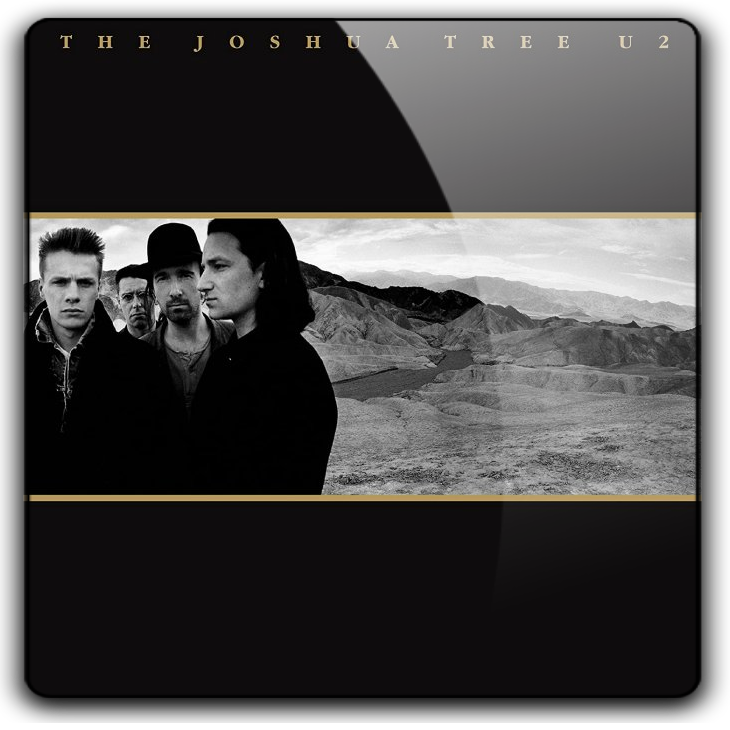
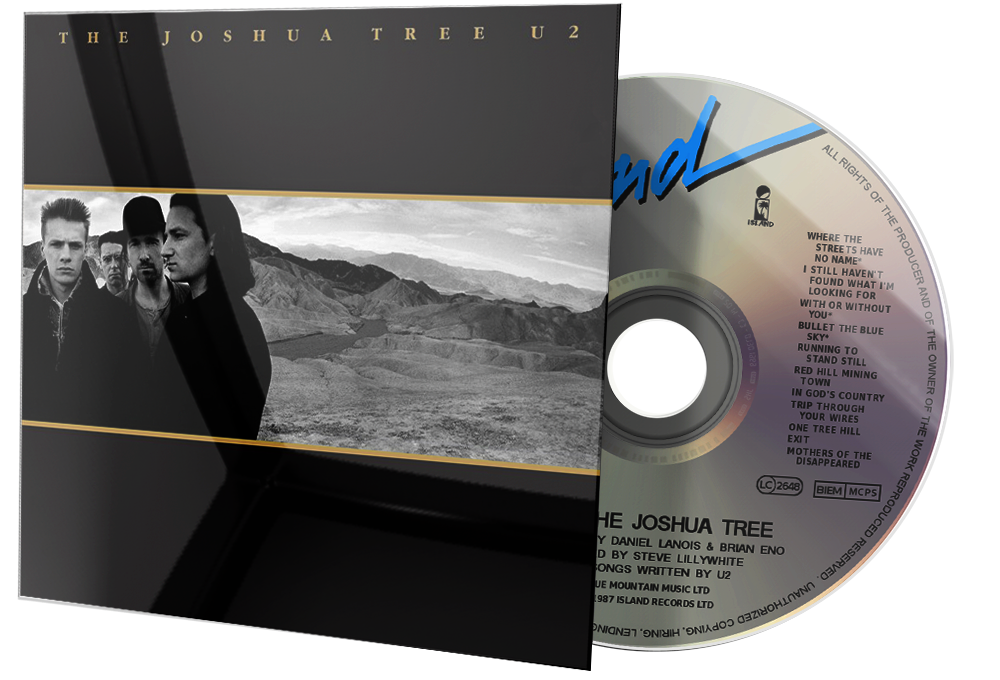
But it wasn’t mere posturing. The Joshua Tree, with its black and white Anton Corbijn sleeve set in Death Valley was a truly widescreen experience. The Edge's arpeggios (here used to great effect on the opener, Adam Clayton's rattling traps and Larry Mullen's rumbling, single note runs were alchemically transformed by Eno and Lanois into pure Americana, complete with wailing harmonicas ("Trip Through Your Wires") and endless references to deserts and water.
With the first three tracks all conquering the singles charts on both sides of the Atlantic, U2 were now here to stay. Unfortunately it also signalled a point where they began to take themselves a little too seriously (as evinced by their ponderous Rattle And Hum film). But The Joshua Tree ”“ voted number 26 in Rolling Stone's top 500 albums of all time - 20 years on, it remains their finest moment to this day.
External Album Reviews
None...
User Comments

Available in:
Sorti le 9 mars 1987 sur Island Records, The Joshua Tree marque le passage de U2 du statut de groupe à succès à celui de superstars mondiales.
Produit par Daniel Lanois et Brian Eno, cet album rompt avec les expérimentations ambiantes de The Unforgettable Fire pour privilégier une approche plus directe et structurée, ancrée dans les racines du rock, du blues et du folk américain.
Porté par une fascination profonde — mêlée de critique sociale — pour les grands espaces et le rêve américain, le disque capture une atmosphère « cinématographique » unique. Les singles iconiques « With or Without You », « I Still Haven't Found What I'm Looking For » et « Where the Streets Have No Name » illustrent parfaitement cette maturité artistique.
Récompensé par deux Grammy Awards en 1988, dont celui de l'album de l'année, l'ouvrage s'est vendu à plus de 25 millions d'exemplaires. En explorant des thèmes spirituels et politiques, Bono et ses compagnons ont réussi à créer une œuvre intemporelle, régulièrement citée comme l'un des plus grands albums de l'histoire du rock.
Une édition remasterisée pour son 20e anniversaire a été publiée en 2007, confirmant son statut d'œuvre fondatrice pour le groupe.
User Album Review
It's hard to imagine these days, but at one time the world didn’t belong to Paul 'Bono' Hewson and his pals. By 1987 the band had undoubtedly become stadium”“fillers in Europe, but it was America that was their heartland, and they were on the verge of cracking it wide open.
Having already establishing their cavernous sound with producer Steve Lillywhite, by 1984 The Unforgettable Fire had the band opting for the more ambient (and subtle) team of Brian Eno and Daniel Lanois. It was a canny move that both allowed them more space to emote in the studio and also perfectly suited the student population in the States, reared on FM radio.
In time-honoured fashion the band toured the US like madmen, and by 1987 the bands' American citizenship-by-osmosis had magically occurred. The Joshua Tree's songs augmented their political stance with bigger subjects such as right-wing intervention in El Salvador (''Bullet The Blue Sky'') and the Mothers Of The Plaza De Mayo in Argentina (''Mothers Of The Disappeared'') In other words, even if the world didn’t yet know it, U2 were now a global brand.
But it wasn’t mere posturing. The Joshua Tree, with its black and white Anton Corbijn sleeve set in Death Valley was a truly widescreen experience. The Edge's arpeggios (here used to great effect on the opener, Adam Clayton's rattling traps and Larry Mullen's rumbling, single note runs were alchemically transformed by Eno and Lanois into pure Americana, complete with wailing harmonicas ("Trip Through Your Wires") and endless references to deserts and water.
With the first three tracks all conquering the singles charts on both sides of the Atlantic, U2 were now here to stay. Unfortunately it also signalled a point where they began to take themselves a little too seriously (as evinced by their ponderous Rattle And Hum film). But The Joshua Tree ”“ voted number 26 in Rolling Stone's top 500 albums of all time - 20 years on, it remains their finest moment to this day.
External Album Reviews
None...
User Comments
No comments yet...
Status
 unlocked
External Links


