 (1 users)

Cover NOT yet available in

Join up for 4K upload/download access
Your Rating (Click a star below)

Track List
02) Cover Me
03) Darlington County
04) Working on the Highway
05) Downbound Train
06) I'm on Fire
07) No Surrender
08) Bobby Jean
09) I'm Goin' Down
10) Glory Days
11) Dancing in the Dark
12) My Hometown
01) Born in the U.S.A.
02) Cover Me
03) Darlington County
04) Working on the Highway
05) Downbound Train
06) I'm on Fire
07) No Surrender
08) Bobby Jean
09) I'm Goin' Down
10) Glory Days
11) Dancing in the Dark
12) My Hometown
01) Born in the U.S.A.

3:28
4:50
3:15
3:37
2:41
4:02
3:48
3:31
4:18
4:05
4:36
4:39
Data Complete 80%
Total Rating
Total Rating
 (8 users)
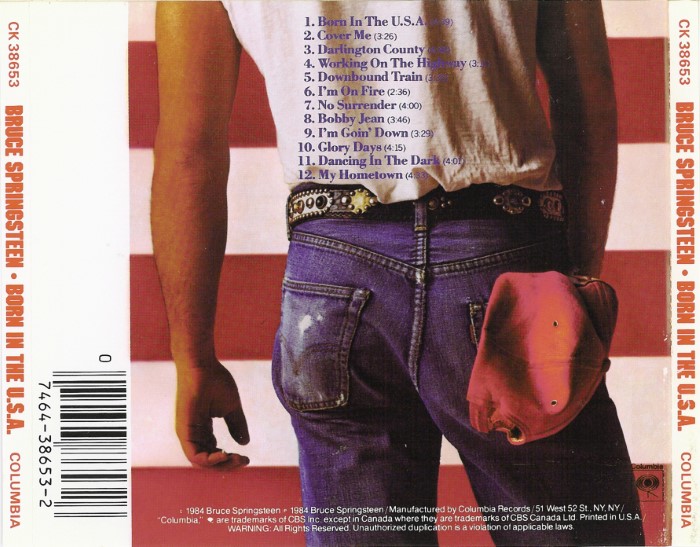
Back Cover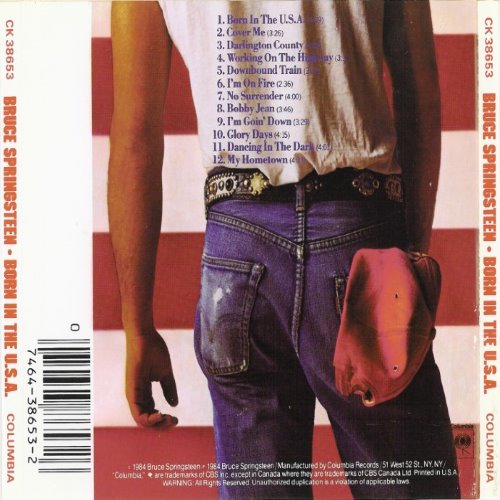
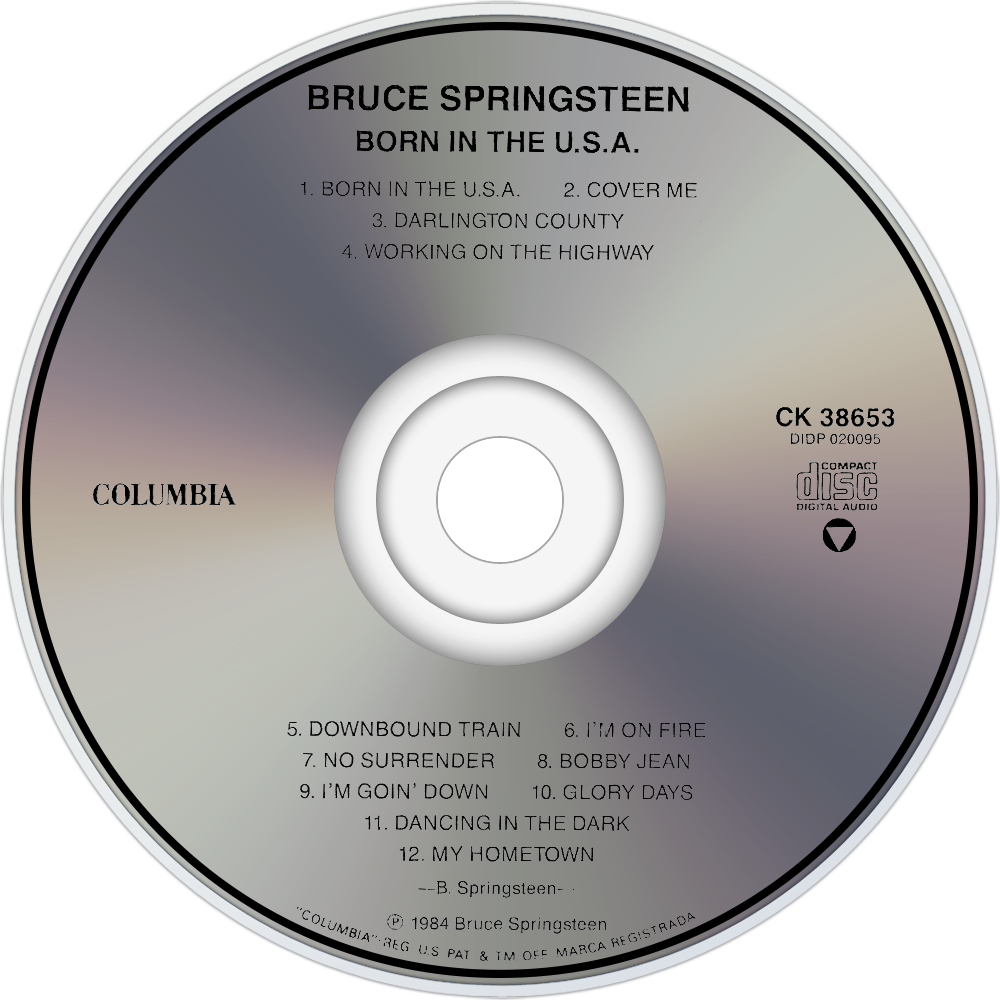
CD Art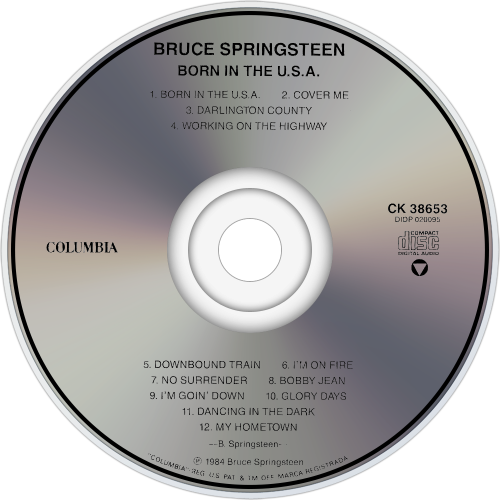
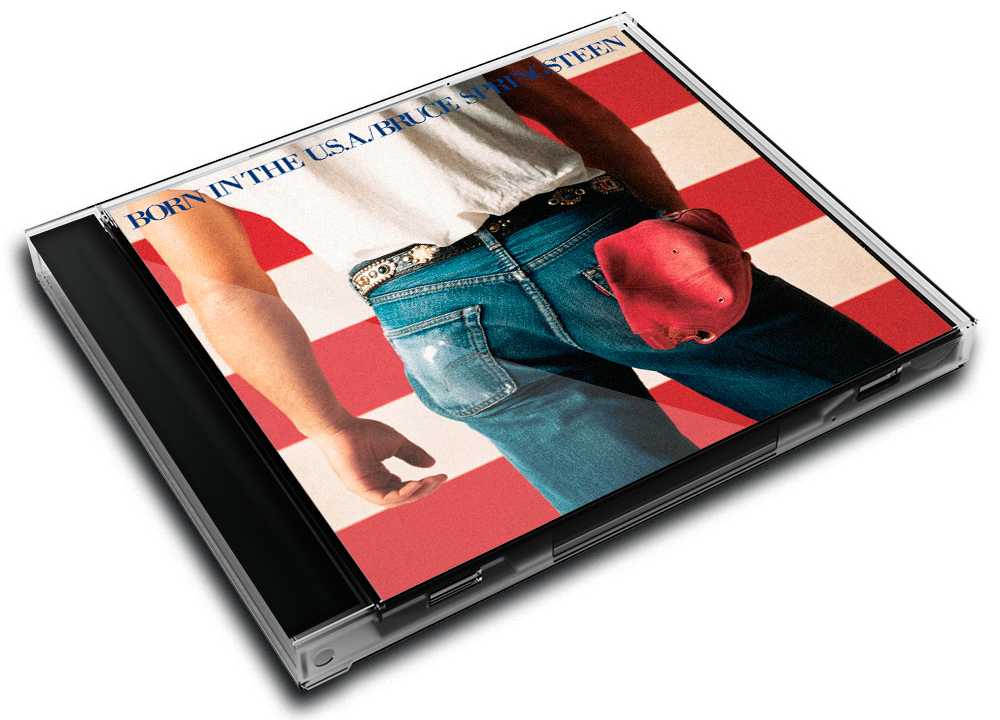
3D Case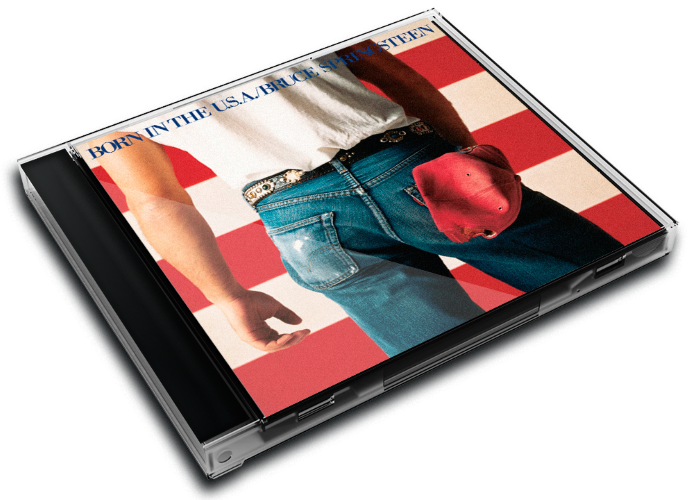
3D Thumb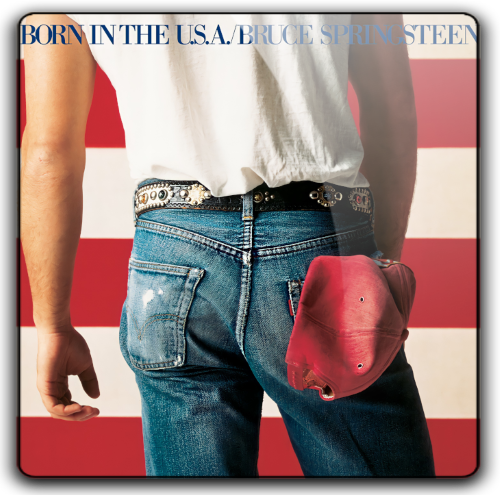
3D Flat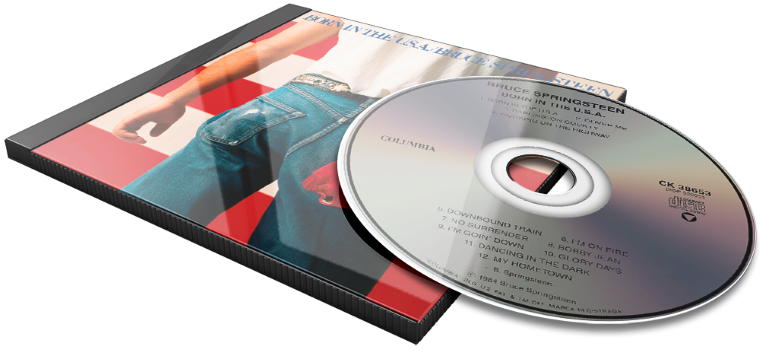
3D Face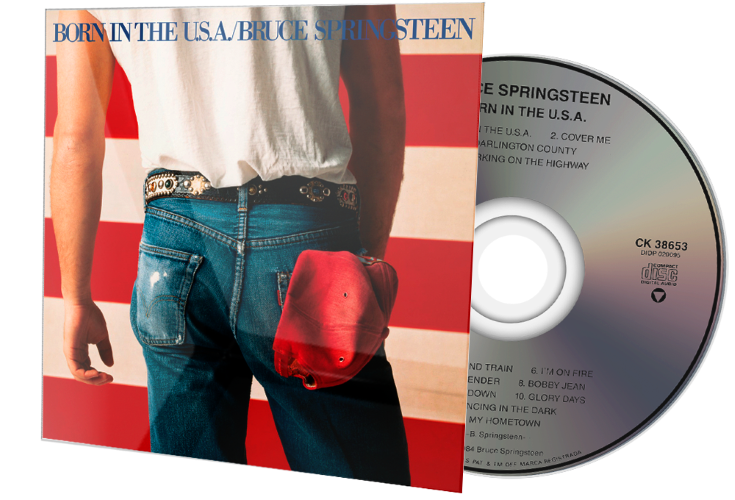
3D Spine
First Released
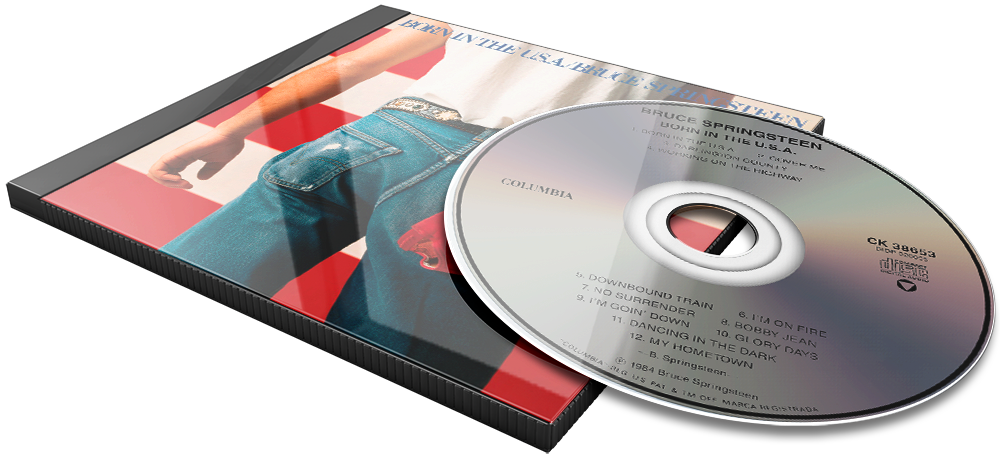
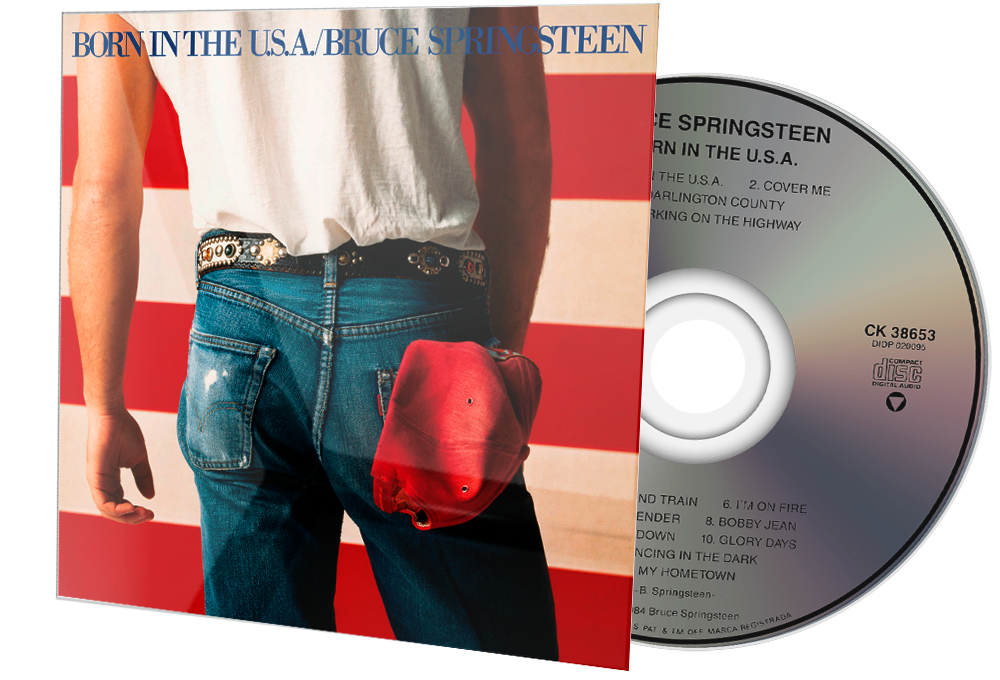
 1984
1984
 Rock
Rock
 Enlightened
 Rock/Pop
---
 Medium
 Album
Album
24/100
 888880330246
 30,000,000 copies
Album Description
Available in:

Born in the U.S.A. (1984) est le septième album studio de Bruce Springsteen.
Marquant une rupture avec l'acoustique sombre de Nebraska, cet opus intègre des arrangements au synthétiseur et une production pop-rock calibrée pour les ondes FM, propulsant le "Boss" vers une popularité mainstream mondiale.
L'album a dominé les charts en devenant la meilleure vente de l'année 1985 aux États-Unis et en égalant le record de sept singles classés dans le Top 10.
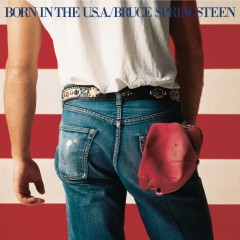
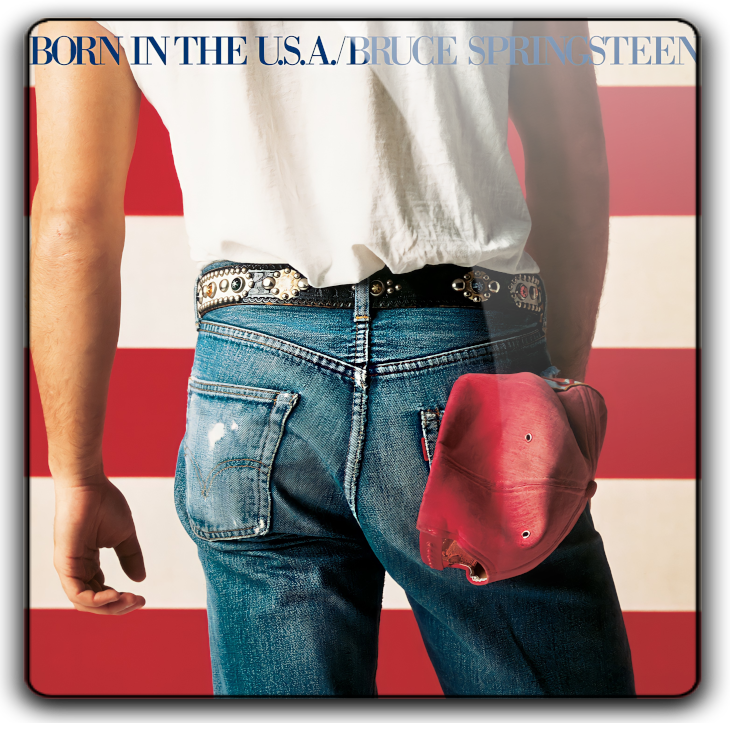
Bien que sa pochette, signée par la photographe Annie Leibovitz, et son morceau-titre soient souvent interprétés à tort comme des symboles de patriotisme aveugle, les textes explorent en réalité les luttes sociales et les désillusions de l'Américain moyen face au rêve américain.
Considéré comme son opus magnum avec Born to Run, ce disque reste son plus immense succès commercial.

User Album Review
East Berlin, 1988. Under a graphite sky, a familiar synthesizer riff echoes out over a vast arena. As a thundercrack snare drum underscores one of the most consistently spine-chilling intros ever, Bruce Springsteen, telecaster in hand, stares out toward half a million East Germans who've all started singing the chorus - before he's even begun the first verse.
500,000 Germans shouting "Born In The USA" in some huge-ass park in the late-eighties is plainly quite weird. But they're not American. They're not singing about being American, are they? Are they??
"Born In The USA", the title track of The Boss' mega-selling 1984 album, was much misunderstood. Accused at the same time of being repulsively nationalistic, and viciously Anti-American, the track was endorsed by conservative US politicians (including Ronald Reagan) as an exemplar of "classic American values" whilst the bitter lyrics actually tell the story of disaffected Vietnam veteran, chewed up and spat out by his own country:
'I had a buddy at Khe Sahn
Fighting off the Viet Cong
They're still there, he's all gone
He had a little girl in Saigon
I got a picture of him in her arms'
Fire up YouTube and watch John Sayles' music video for the track. The killer punch comes near the end where you see the smiling veteran with a hole where his left eye should be.
Despite the poor sync between the video and audio, Springsteen's leather-clad delivery is scarily fierce. Heard alongside the visuals of Bruce spitting the hopeless verses, the song is revealed as far more than a knuckleheaded, jingoistic sing-a-long. It's a ragged-lunged hymn to long gone friends, a treacherous government, a stupid war, having no job, but f*** it, let’s shout the chorus until we cough up our lungs.
Springsteen’s much-discussed genius lies in finding the humanity in the everyday, punching it out with a grizzled kind of grandeur, and managing it dressed as Mad Max. That’s why our German friends, with their cold war blues and bad blow-dries, are singing along in their hundreds of thousands. Despite huge political and national gulfs, there are more similarities than there are differences.
The other songs on the album? Apart from the unsettling, tender "I’m On Fire", it’s familiar fare throughout, reliable rock and soul courtesy of Bruce and his band of E Street musos, with the added bonus of "Glory Days" and the irrepressible "Dancing In The Dark" chucked in too.
But at no point does it become as stupid, or as complex, as track 1.
External Album Reviews
None...
User Comments

Available in:
Born in the U.S.A. (1984) est le septième album studio de Bruce Springsteen.
Marquant une rupture avec l'acoustique sombre de Nebraska, cet opus intègre des arrangements au synthétiseur et une production pop-rock calibrée pour les ondes FM, propulsant le "Boss" vers une popularité mainstream mondiale.
L'album a dominé les charts en devenant la meilleure vente de l'année 1985 aux États-Unis et en égalant le record de sept singles classés dans le Top 10.
Bien que sa pochette, signée par la photographe Annie Leibovitz, et son morceau-titre soient souvent interprétés à tort comme des symboles de patriotisme aveugle, les textes explorent en réalité les luttes sociales et les désillusions de l'Américain moyen face au rêve américain.
Considéré comme son opus magnum avec Born to Run, ce disque reste son plus immense succès commercial.
User Album Review
East Berlin, 1988. Under a graphite sky, a familiar synthesizer riff echoes out over a vast arena. As a thundercrack snare drum underscores one of the most consistently spine-chilling intros ever, Bruce Springsteen, telecaster in hand, stares out toward half a million East Germans who've all started singing the chorus - before he's even begun the first verse.
500,000 Germans shouting "Born In The USA" in some huge-ass park in the late-eighties is plainly quite weird. But they're not American. They're not singing about being American, are they? Are they??
"Born In The USA", the title track of The Boss' mega-selling 1984 album, was much misunderstood. Accused at the same time of being repulsively nationalistic, and viciously Anti-American, the track was endorsed by conservative US politicians (including Ronald Reagan) as an exemplar of "classic American values" whilst the bitter lyrics actually tell the story of disaffected Vietnam veteran, chewed up and spat out by his own country:
'I had a buddy at Khe Sahn
Fighting off the Viet Cong
They're still there, he's all gone
He had a little girl in Saigon
I got a picture of him in her arms'
Fire up YouTube and watch John Sayles' music video for the track. The killer punch comes near the end where you see the smiling veteran with a hole where his left eye should be.
Despite the poor sync between the video and audio, Springsteen's leather-clad delivery is scarily fierce. Heard alongside the visuals of Bruce spitting the hopeless verses, the song is revealed as far more than a knuckleheaded, jingoistic sing-a-long. It's a ragged-lunged hymn to long gone friends, a treacherous government, a stupid war, having no job, but f*** it, let’s shout the chorus until we cough up our lungs.
Springsteen’s much-discussed genius lies in finding the humanity in the everyday, punching it out with a grizzled kind of grandeur, and managing it dressed as Mad Max. That’s why our German friends, with their cold war blues and bad blow-dries, are singing along in their hundreds of thousands. Despite huge political and national gulfs, there are more similarities than there are differences.
The other songs on the album? Apart from the unsettling, tender "I’m On Fire", it’s familiar fare throughout, reliable rock and soul courtesy of Bruce and his band of E Street musos, with the added bonus of "Glory Days" and the irrepressible "Dancing In The Dark" chucked in too.
But at no point does it become as stupid, or as complex, as track 1.
External Album Reviews
None...
User Comments
No comments yet...
Status
 unlocked
External Links


