 (0 users)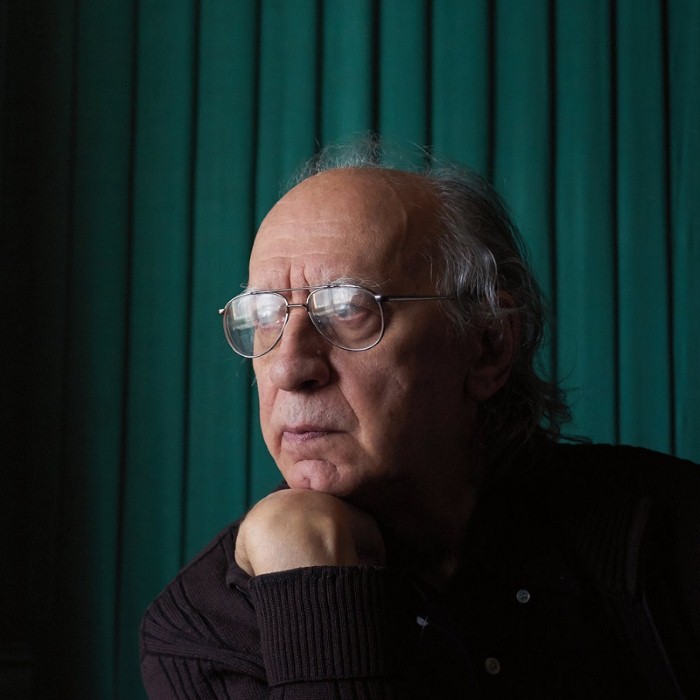
 view
viewMembers
1 Male
Popularity
---
Followers
---
Origin
 Ukrainian
Genre
 Composer
Style
Classical
Mood
---
Born
1 Male
Popularity
---
Followers
---
Origin
UkrainianGenre
ComposerStyle
Classical
Mood
---
Born
1937
Active ---Present...
Cutout
Alternate Name
Valentin Silvestrov
 Most Loved Tracks
No loved tracks found...
 Music Video Links
Artist Biography
Available in:

Valentyn Vasylyovych Sylvestrov (Ukrainian: Валенти́н Васи́льович Сильве́стров) born 30 September 1937 in Kiev (Kyiv) (Ukrainian SSR) is a Ukrainian composer and pianist of contemporary classical music.
Sylvestrov began private music lessons at age 15. He studied piano at the Kiev Evening Music School from 1955 to 1958, then at the Kiev Conservatory from 1958–1964; composition under Borys Lyatoshynsky, harmony and counterpoint under Levko Revutsky.
Sylvestrov is perhaps best known for his post-modern musical style; some, if not most, of his works could be considered neoclassical and post-modernist. Using traditional tonal and modal techniques, Sylvestrov creates a unique and delicate tapestry of dramatic and emotional textures, qualities which he suggests are otherwise sacrificed in much of contemporary music. "I do not write new music. My music is a response to and an echo of what already exists," Sylvestrov has said.
In 1974, under pressure to conform to both official precepts of socialist realism and fashionable modernism, and likewise to apologise for his walkout from a composers' meeting to protest the Soviet Union invasion of Czechoslovakia, Sylvestrov chose to withdraw from the spotlight. In this period he began to reject his previously modernist style. Instead, he composed Quiet Songs (Тихі Пісні (1977)) a cycle intended to be played in private. Later, after the fall of the Soviet Union, he also began to compose spiritual and religious works influenced by the style of Russian and Ukrainian Orthodox liturgical music.
Sylvestrov's Symphony No. 5 (1980–1982), considered by some to be his masterpiece, may be viewed as an epilogue or coda inspired by the music of late Romantic composers such as Gustav Mahler. "With our advanced artistic awareness, fewer and fewer texts are possible which, figuratively speaking, begin 'at the beginning'... What this means is not the end of music as art, but the end of music, an end in which it can linger for a long time. It is very much in the area of the coda that immense life is possible.”
Sylvestrov's recent cycle for violin and piano, Melodies of Instances (Мелодії Миттєвостей), a set of seven works comprising 22 movements to be played in sequence (and lasting about 70 minutes), is intimate and elusive - the composer describes it as "melodies on the boundary between their appearance and disappearance".
Elements of Ukrainian nationalism occur in some of Sylvestrov's works, most notably in his choral work Diptych. This work sets the strongly patriotic words of Taras Shevchenko's 1845 poem Testament , which has a significant national status in Ukraine, and Sylvestrov dedicated it in 2014 to the memory of Sergey Nigoyan, an Armenian-Ukrainian who died in the 2014 Hrushevskoho Street riots and is believed to have been the first casualty of the events that led to the Euromaidan.

Wide Thumb
Clearart
Fanart

Banner
User Comments
 No comments yet..